
Ocean Fever: Deep Thoughts On Water, Culture, and Climate Resilience
At Radcliffe, Verchick is writing a book for nonexperts about how we can harness the power of government, science, and local wisdom to rescue the oceans from climate breakdown.
At Radcliffe, Verchick is writing a book for nonexperts about how we can harness the power of government, science, and local wisdom to rescue the oceans from climate breakdown.

Two hundred years ago, the residents of metropolitan Boston faced a climate crisis. White settlers had destroyed the region’s pine forests, triggering dangerous disruptions to both water and carbon cycles. Activists responded by creating forest parks on previously disrupted landscapes. But many of these activists were themselves descended from the settlers who had caused the harm they sought to heal. In imperfect yet instructive ways, they blended ecological care with new forms of ancestral devotion. Gradually they learned what indigenous communities had long known: that care for the more-than-human-world is inseparable from care for our ancestors. In this session, Dan McKanan, will discuss these stories and how they can help contemporary Bostonians, and others, recognize that what makes a place wild is not the absence of humans but the presence of ancestors.
Environmental catastrophes can create a break in the experience of time, they can rupture the possibility of collective meaning. Yet for communities shaped by colonialism and racism, this rupture can only be understood in relation to the past, as an event in the “unceremoniously archived procession of our catastrophes,” to use Édouard Glissant’s words. Histories of colonial and racial devastation teach us that environmental futures are linked to our pasts. We may describe them as “ancestral catastrophes,” as Elizabeth Povinelly suggests. In this session, Mayra Rivera explores the question, “How may we engage those stories in ways that honor our pasts and open possibilities for different futures?”
Speaker: Mayra Rivera, Andrew W. Mellon Professor of Religion and Latinx Studies
Moderator: Diane L. Moore, Diane L. Moore, Associate Dean of Religion and Public Life

Looking closely at nature can inspire a broad range of imaginative artwork, from abstraction and decorative work to illustration and cartooning. In this workshop, we will use a variety of examples from nature as inspiration, and then explore techniques for unleashing our creativity through the drawing process.
Class size will be limited to twelve, allowing ample time for individual feedback. All skill levels are welcome.
Taught by artist and illustrator, Erica Beade.
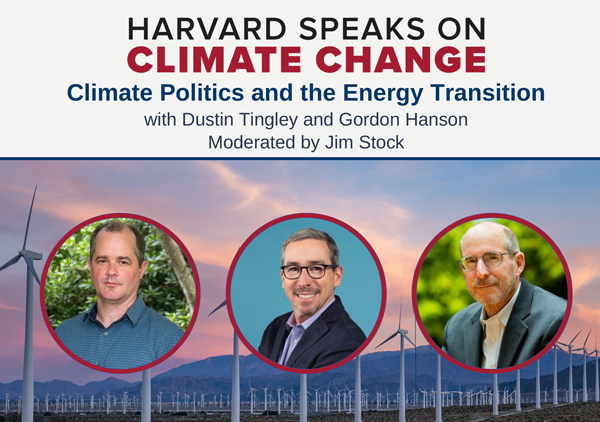
The Salata Institute for Climate and Sustainability and the Vice Provost Office for Advances in Learning present Harvard Speaks on Climate Change, a new series featuring Harvard faculty working on different dimensions of the climate challenge. In this session, Professors Dustin Tingley and Gordon Hanson will explore the political, economic, and social challenges surrounding the energy transition. Dustin will share insights from his recently released book co-authored with Alexander Gazmararian, Uncertain Futures: How to Unlock the Climate Impasse, and Gordon will discuss his research on mitigating the economic impacts of the energy transition on workers, a key initiative of the Kennedy School’s Reimagining the Economy Project, which he co-directs with Dani Rodrik. Vice Provost for Climate and Sustainability and Director of the Salata Institute, Jim Stock, will host. This series is part of the collection of VPAL Signature Events and is co-sponsored by the Harvard Alumni Association.
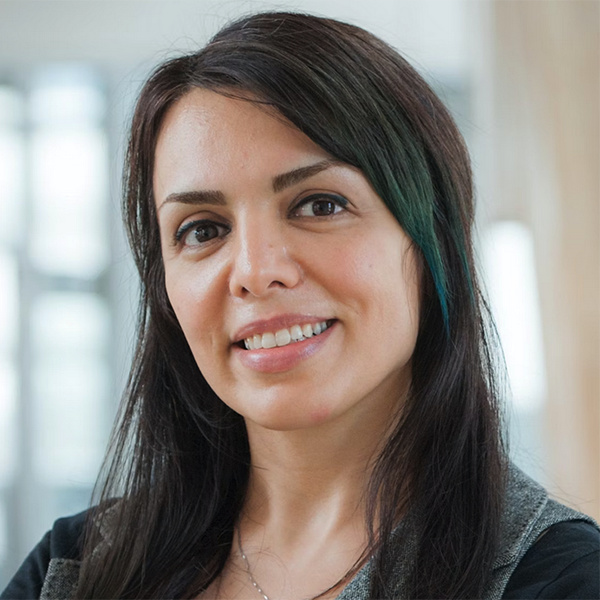
Narges Mahyar is an assistant professor at the Manning College of Information and Computer Sciences, University of Massachusetts Amherst, whose research is situated at the intersection of human-computer interaction, information visualization, social computing, applied machine learning, human-centered artificial intelligence, and design. She applies a community-centered design approach to build novel social computing and visualization tools to empower the general public to engage in real-world sociotechnical issues, such as urban planning and climate change, by enabling them to share their ideas and comments for shaping future policies.
In this lecture, Mahyar will speak about her project to discover innovative techniques to integrate situated visualization, augmented reality, and civic technology to design and build a mobile platform that simulates the localized impact of climate change, thereby providing Boston residents with an immersive experience of climate change visualizations and empowering them to contribute comments and ideas on climate change issues. The platform will benefit the movement towards more equitable resilience by creating new opportunities for the public, especially the underserved communities, to raise their voices and join the discourse.
Her recognition in the field has been repeatedly confirmed through many accolades for her research, including seven best or honorable mention paper awards from top conferences in her field. She holds a PhD in computer science from the University of Victoria. She was a postdoctoral fellow in the Computer Science department at the University of British Columbia from 2014 to 2016 and in the Design Lab at the UC San Diego from 2016 to 2018.
The Salata Institute for Climate and Sustainability and the Vice Provost Office for Advances in Learning present Harvard Speaks on Climate Change, a new series featuring Harvard faculty working on different dimensions of the climate challenge. In this upcoming session, Professor Kari Nadeau will delve into the critical intersection of climate and health. Her insights will shed light on the significance of this relationship, especially as we approach COP28, where the topic of health is being addressed for the first time. Professor and Vice Provost for Climate and Sustainability Jim Stock will host. This series is part of the collection of VPAL Signature Events and is co-sponsored by the Harvard Alumni Association.

The energy transition is causing a surge in demand for minerals for clean energy technologies, giving rise to concerns about the sources and security of supplies of critical materials. Learn more at this event co-sponsored by the Davis Center for Russian and Eurasian Studies at Harvard University and Norwegian Institute of International Affairs (NUPI).

Are you interested in applying to the Council of Sustainability Leaders this year? Attend an upcoming info session on Thursday, September 7, 2023, to learn about CSSL!

Disease ecologist Courtney Murdock will focus on understanding the climate variables that influence mosquito-borne disease transmission. Deploying advanced models of climate-based disease spread, Murdock’s research seeks to predict transmission patterns in order to respond to the epidemiological effects of the climate crisis.

Human geographer Garrett Dash Nelson will explore the uneven distributions of harm, responsibility, vulnerability, and power, in both historical and local perspectives.
Join CID on Friday, April 14 at 12-1 pm ET as they present Isabel Saint Malo, Senior Policy Adviser to the Administrator of the United Nations Development Program, Former Vice President of Panama.