How to create:

Sustainable Offices

Creating sustainable offices and workplaces requires small but meaningful actions. By making more informed purchasing decisions, such as buying products that are reusable, evergreen, and made of sustainable materials, we can collectively reduce the demand for disposable and single-use items that go to landfills and negatively impact climate, health, and equity.

The Harvard Office for Sustainability created a Sustainable Office Guide as a starting point for offices and workplaces to begin their sustainability journeys:

Sustainable Office Guide Tips:

Follow these office tips to help your team make sustainable purchasing decisions that prioritize climate, health, and equity:

Book Icon

Tip # 1

Use resources like the Harvard Sustainable Meeting & Event Guide and Sustainable Purchasing Guide.


Tip #2

Reduce exposure to “chemical classes of concern” in purchased products.

  • Choose BPI-certified compostable food service products (made without PFAS).
  • When appropriate, avoid antimicrobial hand soaps, products treated for water resistance or stain-repellents, and furniture with added chemical flame retardants.

Chemical Icon

Bulk Order Icon

Tip #3

Purchase reusables and bulk items instead of disposables and single-use items.

For example, instead of individual coffee pod systems, opt for bean-to-cup coffee machines so you can use your favorite fair-trade coffee.


Tip #4

For giveaways (“swag”), choose evergreen items people will use repeatedly.

Merchandise Icon

Printer Icon

Tip #5

Replace personal printers with shared equipment connected to a managed print environment (e.g., Crimson Print).


Tip #6

Conveniently place compost, recycling, and trash bins with the latest signage.
Recycling bins icon, one with a glass bottle, another with a paper, and another with a plastic bottle

Icon of Light bulb with  a leaf in the middle

Tip #7

Support colleagues in implementing energy-efficient actions whenever possible such as:

  • Power down computers and electronics at the end of the day or before vacations.
  • Choose LED bulbs & install motion-sensor lights in common areas.
  • Ensure your community knows how to report resource conservation issues (e.g., leaking faucets) to building management.
  • Sign up for Demand Response notifications by emailing uos_operations@harvard.edu.

Tip #8

Work with HUIT (or local IT group) and FMO to properly dispose of electronic waste.

Broken phone and computer mouse icon

Icon of three people setting up a tent

Tip #9

Set aside unwanted office supplies to donate to Freecycle events or reuse rooms.


Tip #10

Choose “100% recycled” or “tree-free” paper products.

Recycled Paper icon

Ready to make more informed, sustainable purchasing decisions for your office? Contact rachel_martinez@harvard.edu to request the Sustainable Office Worksheet, a resource designed by the Harvard Office for Sustainability to help purchasers follow best practices.

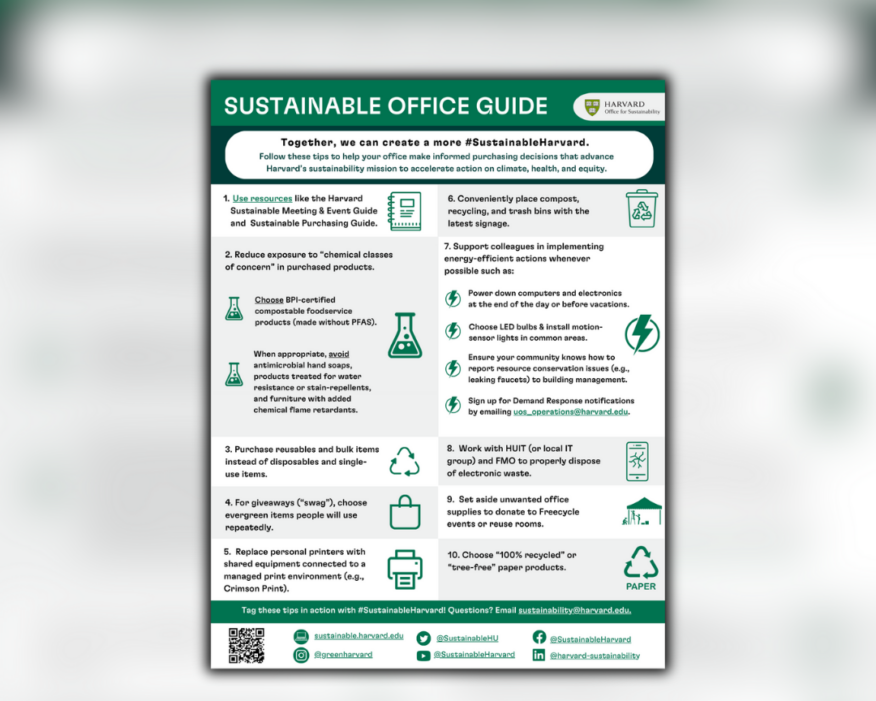
Sustainable Office Guide

The guide enables offices to make informed purchasing and operations decisions that help advance Harvard’s mission to accelerate action on climate, health, and equity.
Download the Sustainable Office GuideOpens new window

A photo of the Sustainable Office Guide cover with tips on how to create a sustainable office.
featured

Sustainability Resources

Explore sustainability resources at Harvard.

Learn More
2023_Harvard Spring Campus Beauty-05

Upcoming Events

October

14

Wednesday
11:00 am-2:00 pm GMT+0000

Community Freecycle

Join us at our community Freecycle in the Smith Campus Center!

Drop off reusable goods you no longer need, and browse an excellent selection of items brought by others. Popular items include books, clothes, and household goods. Only donate items in clean and working condition.

Everyone is welcome, and no donation is necessary to shop!

September

09

Wednesday
11:00 am-2:00 pm GMT+0000

Community Freecycle

Join us at our community Freecycle in the Smith Campus Center!

Drop off reusable goods you no longer need, and browse an excellent selection of items brought by others. Popular items include books, clothes, and household goods. Only donate items in clean and working condition.

Everyone is welcome, and no donation is necessary to shop!

November

20

Friday
1:00 pm-4:30 pm GMT+0000

Salata Institute Climate and Sustainability Career Expo

Are you a Harvard or MIT student or alumni interested in a career in climate and sustainability? Or an employer interested in reaching Harvard University and MIT students with career opportunities? The Salata Institute Climate and Sustainability Career Expo is a collaborative effort across Harvard schools and MIT to connect organizations focused on climate, sustainability, and the environment with Harvard undergraduates, graduate students, and alumni. Join us for the next expo on Friday, November 20, 2026 from 1:00 – 4:30pm.

September

09

Wednesday
5:00 pm-6:00 pm GMT+0000

Council of Student Sustainability Leaders (CSSL) Info Session

INFO SESSION (required to apply for CSSL program): Please RSVP by September 8 to attend the CSSL Info Session on September 9 @ 5-6pm. If you cannot attend, you must watch the recording (which will be posted here on September 10) before applying.

November

17

Tuesday
2:00 pm-3:00 pm GMT+0000

Sustainability Spotlight: Geothermal Heating at Weld Hill

Did you know that the Weld Hill Research Building at the Arboretum has the largest geothermal heating system at Harvard? There are 88 wells hidden under the namesake hill which help heat and cool the state-of-the-art research building. Join Head of Operations and Project Management Danny Schissler for a behind-the-scenes look at this fascinating system.

This tour will be a mix of indoors and outdoors.

September

16

Wednesday
12:30 pm-1:30 pm GMT+0000

Sustainability Spotlight: Irrigation

As climate change leads to increased temperatures and extreme weather patterns, drought is becoming more and more of a concern at the Arboretum. Staff have been working hard to install irrigation systems around the landscape since the record-breaking drought of 2016, working to increase the resiliency of our collections to periods of drought and dry weather, and this fall represents one of the biggest irrigation projects yet. Join Head of Operations and Project Management Danny Schissler and Head Operator Jed Romanowiz to learn how the Arboretum keeps trees watered in areas without irrigation, the Arboretum’s plans for new irrigation installations, and how all of these systems actually work.